
Video Edit SDK .NET — C# Video Editor: Cut, Merge & Add Transitions
Video Edit SDK .NET is a video editing SDK for WPF, WinForms, MAUI, Avalonia and Unity apps in C#, on Windows, macOS, Linux, Android and iOS. It trims and joins clips on a timeline with transitions, effects and titles, and exports MP4, WebM, MP3, AAC and more with hardware-accelerated encoding.
Cross-platform support for Windows, macOS, Linux, Android, and iOS
From €250/year · Lifetime from €900 Bundles from €700/year
The cross-platform VideoEditCoreX engine is built on GStreamer Editing Services, and the classic VideoEditCore engine uses DirectShow on Windows only. Clips go onto the timeline through Input_AddVideoFile and Input_AddAudioFile, and the movie renders when Start is called. Output formats include MP4, WebM, MKV, MOV, AVI, MPEG-TS, MXF and animated GIF, plus audio-only MP3, M4A, FLAC, OPUS and WAV. Hardware encoding uses NVIDIA NVENC, Intel Quick Sync or AMD AMF when the GPU supports it. For example, a batch tool can join an intro, a screen recording and an outro, add a logo and background music, and save one MP4. Installation starts with the VisioForge.DotNet.VideoEdit NuGet package.
What is a video editing SDK?
A video editing SDK is a library that adds timeline editing to your own application. Your code places clips on a timeline, trims them, adds transitions, titles and effects, previews the result and renders a new file. Video Edit SDK .NET does this in .NET applications: desktop apps built with WinForms, WPF, Avalonia or .NET MAUI, console and server tools that render in batches, Android and iOS apps through .NET MAUI, and Unity projects. Unlike running FFmpeg from the command line, the timeline, the preview and the progress events stay inside your process. Unlike editor SDKs for the browser, it does not run in a web page; a web product calls it on the server instead.
Quick facts
| Platforms | Windows 10/11 and Windows Server 2016+, macOS 12+, Linux, Android 9+, iOS 16.4+ |
|---|---|
| UI frameworks | WinForms, WPF, Avalonia, .NET MAUI, Uno Platform, Unity; console apps |
| .NET | .NET Framework 4.6.1+, .NET Core 3.1, .NET 5–10 |
| Engines | VideoEditCoreX (cross-platform, GStreamer Editing Services); VideoEditCore (Windows, DirectShow) |
| Input | Video, audio and image files and .NET streams, trimmed by start and stop time |
| Output | 20 formats on VideoEditCoreX, including MP4, WebM, MKV, MOV, MPEG-TS, MXF, animated GIF, MP3, FLAC and WAV |
| Hardware encoding | NVIDIA NVENC, Intel Quick Sync, AMD AMF; MediaCodec on Android; VideoToolbox on macOS and iOS |
| Package | VisioForge.DotNet.VideoEdit on NuGet |
| Trial | 30 days, fully functional; a watermark or notice may appear |
| Distribution | Royalty-free, no runtime fees |
Installation
Quick Installation with NuGet
Get started in seconds with our NuGet package
Install-Package VisioForge.DotNet.VideoEditOr search for VisioForge.DotNet.VideoEdit in Visual Studio's NuGet Package Manager.View on NuGet.org →
Key Benefits
Timeline Editing
Multi-track timeline with precise control over video and audio segments
Rich Effects Library
50+ built-in effects, transitions, and filters for professional results
GPU Acceleration
Hardware-accelerated rendering with Intel, NVIDIA, and AMD support
SDK STRUCTURE
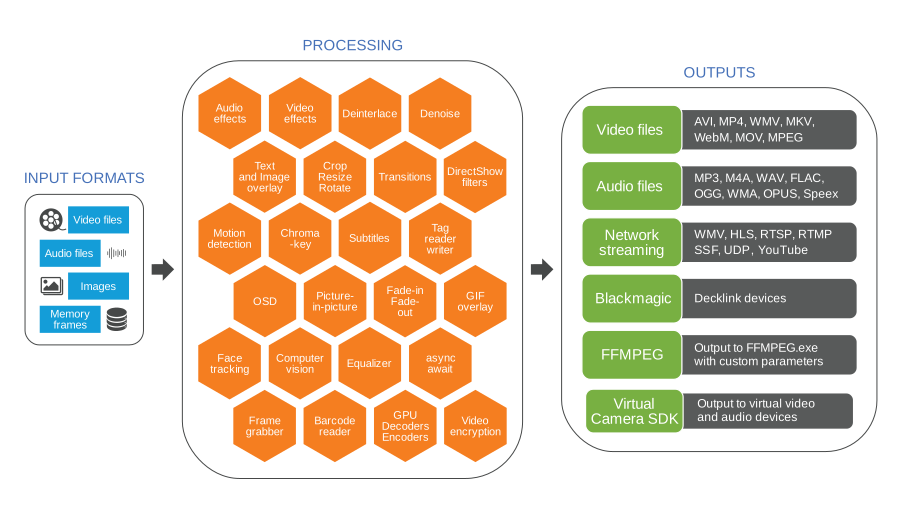
Video Edit SDK .NET has two engines. VideoEditCoreX is the cross-platform engine, built on GStreamer Editing Services, and runs on Windows, macOS, Linux, Android and iOS. VideoEditCore is the classic Windows engine, built on DirectShow. Both take video, audio and image files: AVI, MP4, MPEG-1/2, WMV, QuickTime MOV, VP8/VP9 and AV1 video, WAV, MP3, Vorbis, WMA, AAC, Speex and Opus audio, BMP, PNG, GIF, JPEG, TIFF and WebP images, and any other format for which a decoder is installed. VideoEditCoreX also reads clips and images from a .NET Stream, and every clip can be trimmed by a start and stop time when it is added. VideoEditCoreX writes 20 output formats; VideoEditCore can also stream the result over the network or send it to a Blackmagic DeckLink card.
VIDEO EDITING PIPELINE
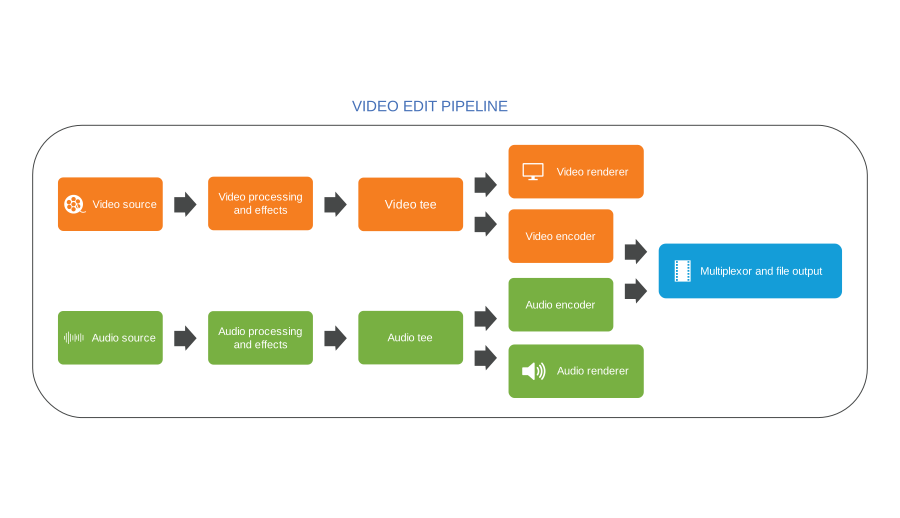
Editing happens on a timeline. On VideoEditCoreX, each Input_Add call places a clip on it: Input_AddAudioVideoFile for a clip with sound, Input_AddVideoFile or Input_AddAudioFile for one track, and Input_AddImageFile for a still with a set duration. Without an insert time a clip goes after the last one; with one, it lands at that point. Input_AddVideoLayer adds a layer for multi-layer composition, such as a watermark over the main clip. When Start is called, the engine decodes each clip, applies transitions, effects and text overlays, encodes the result and writes it in the format set in Output_Format. If Output_Format is left empty, the same timeline plays in the video view as a preview, and Position_Set seeks within it. Progress and errors arrive through the OnProgress, OnError and OnStop events.
OUTPUT FORMATS
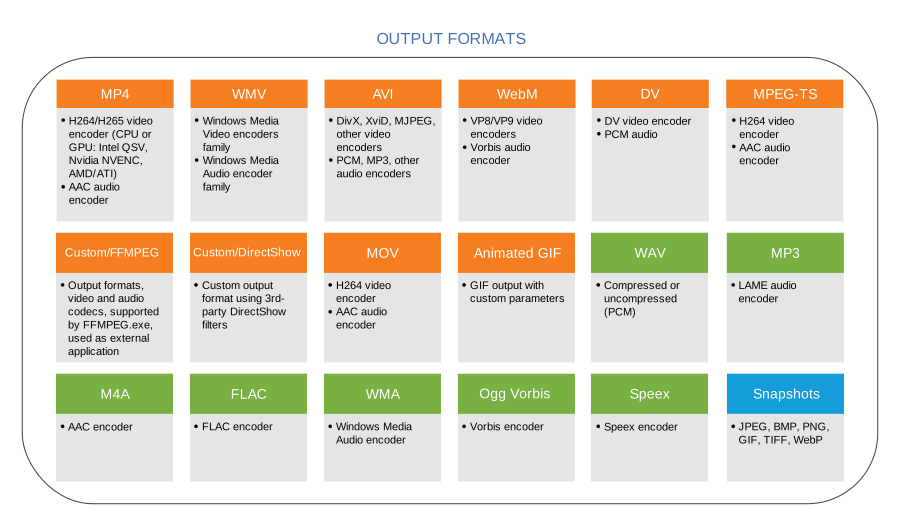
VideoEditCoreX renders to 20 formats through the Output_Format property: MP4, WebM, MKV, MOV, AVI, DV, FLV, MPEG-TS, MXF, WMV, Ogg Theora and animated GIF for video, and MP3, M4A, FLAC, Opus, Ogg Vorbis, Speex, WAV and WMA for audio only. MP4 uses H.264 or HEVC video with AAC audio, encoded in software or on the GPU with NVIDIA NVENC, Intel Quick Sync or AMD AMF; on Android and Apple devices the H.264 encoder uses MediaCodec and VideoToolbox when the device has them. VideoEditCore on Windows adds FFmpeg-based outputs such as MPEG-1/2/4 and FLV, and can encode through any third-party DirectShow filter installed on the system.
VIDEO PROCESSING
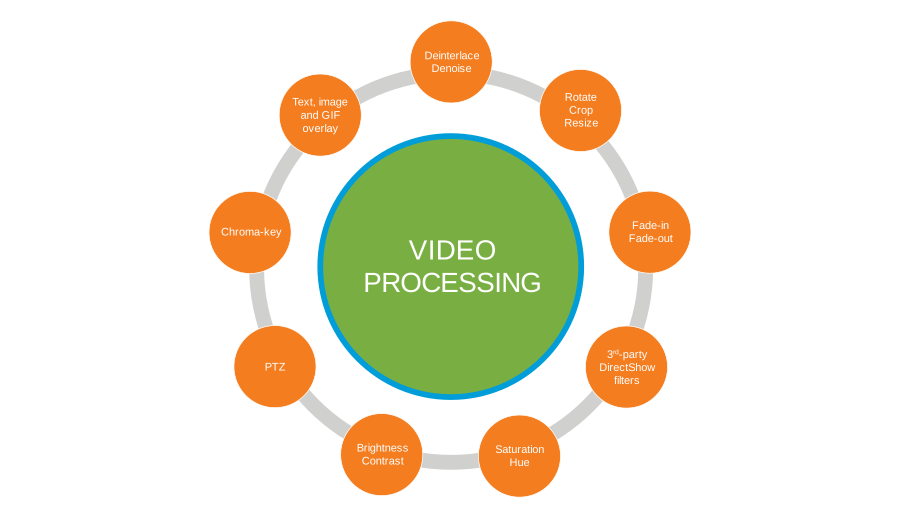
The SDK facilitates the integration of SMPTE-compliant transitions between videos to create smooth, professional-looking transitions. It also enables adding text, images, or GIF logos to your content. Developers can adjust brightness, contrast, saturation, or hue to fine-tune the visual aspects. Furthermore, the SDK supports various operations such as resizing, cropping, and rotating, affording precise control over the video's appearance.
AUDIO PROCESSING
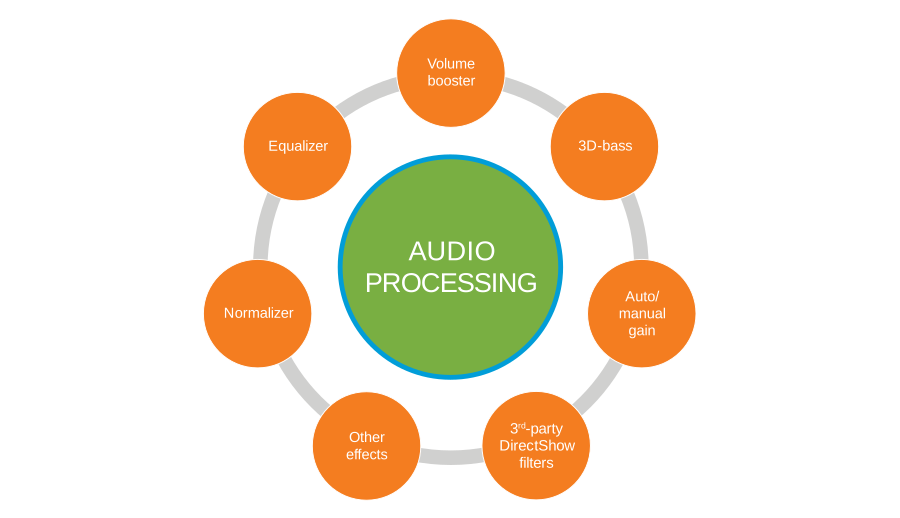
Add an equalizer to your audio processing capabilities with the SDK. This allows you to fine-tune audio frequencies for optimal sound quality. You can also normalize audio levels, increase volume, or enhance bass frequencies to achieve the desired output (normalization and bass on VideoEditCore). The SDK also offers a wide range of other audio effects.
Unity Support
Add a real video editor to Unity 6 with a single, ready-to-import .unitypackage. The high-level VideoEditCoreX engine builds a timeline of clips, applies effects and transitions, previews the result live into a Unity RawImage, and renders the finished movie to MP4. A ready VideoEditX sample scene shows the full preview-and-render flow. One cumulative package targets Windows, Android, macOS, and iOS: import once, switch the Build Target, and build.
High-Level Editing Engine
VideoEditCoreX gives you the same timeline API you use in WinForms, WPF, MAUI, and Avalonia — add clips, trim, sequence, and apply effects and transitions, with no manual pipeline assembly.
One Cumulative Package
Windows, Android, macOS, and iOS native runtimes ship inside a single .unitypackage. Unity picks the right native runtime automatically when you switch the Build Target.
Ready Editing Scene
The included VideoEditX scene composes a multi-clip timeline and renders the preview into a RawImage through the reusable VisioForgeVideoView component, with Stretch, Letterbox, and Crop aspect modes.
Live Timeline Preview
Preview the composed timeline in real time inside Unity before you commit — frames are delivered to the texture through the Unity-only OnVideoFrameUnity event, so editors and creators see exactly what they will get.
Render to MP4
Render the finished timeline to MP4 with hardware-accelerated H.264 / HEVC encoding (NVENC and Quick Sync on Windows, MediaCodec on Android, VideoToolbox on macOS / iOS) — straight from your Unity build.
Render Anywhere in the Scene
The preview frame is uploaded into a Unity Texture2D, so the editor view is not limited to the UI. Show it in a RawImage, or map it onto a material on any 3D object in your scene.
Preview and render a timeline in Unity with VideoEditCoreX
C#// One SDK init (brings up GStreamer); VideoEditCoreX initializes GES in its constructor.
VisioForgeEnvironment.InitializeSdk();
_editor = new VideoEditCoreX();
// Build a timeline by adding clips.
_editor.Input_AddAudioVideoFile("intro.mp4");
_editor.Input_AddAudioVideoFile("main.mp4");
// Preview: no output format → the timeline plays into the Unity texture
// through OnVideoFrameUnity (RGBA32) and VisioForgeVideoView.
_editor.OnVideoFrameUnity += _videoView.OnFrameBuffer;
_editor.Output_Format = null;
_editor.Start();
// To render instead, set an output and start:
// _editor.Output_Format = new MP4Output("result.mp4");
// _editor.Start();Unity editing is delivered through the VideoEditCoreX engine. Verified on Unity 6 (6000.x); requires the .NET Standard 2.1 API Compatibility Level. All four SDKs ship in one cumulative .unitypackage built from the same SDK source as the VisioForge.DotNet.Core NuGet — the package build date and NuGet version are tracked separately.
View Unity documentation →Video Editing on Android and iOS
The same VideoEditCoreX timeline runs inside a .NET MAUI app on Android and iOS, as well as on Mac Catalyst and Windows, from one codebase. Add clips from the device gallery, preview the result in the MAUI VideoView control, and render an MP4 file on the device. H.264 goes to the hardware encoder when the device has one, MediaCodec on Android and VideoToolbox on iOS, and to a software encoder otherwise. The NuGet packages are VisioForge.DotNet.VideoEdit and VisioForge.DotNet.Core.UI.MAUI, plus a redistributable for each target platform.
Join two clips into an MP4 in a .NET MAUI app
C#using VisioForge.Core;
using VisioForge.Core.MediaBlocks.VideoEncoders;
using VisioForge.Core.Types.X.Output;
using VisioForge.Core.VideoEditX;
// Load the native stack before the first VideoEditCoreX is created
await VisioForgeX.InitSDKAsync();
// videoView is the VisioForge MAUI VideoView control on the page
var core = new VideoEditCoreX(videoView.GetVideoView());
// Each call appends the clip after the last one on the timeline
core.Input_AddAudioVideoFile(firstClipPath);
core.Input_AddAudioVideoFile(secondClipPath);
// Hardware H.264 where the device has it (MediaCodec on Android,
// VideoToolbox on iOS), software encoder otherwise
var output = Path.Combine(FileSystem.Current.AppDataDirectory, "joined.mp4");
core.Output_Format = new MP4Output(output, H264EncoderBlock.GetDefaultSettings());
core.Start();Major Features
VisioForge Video Edit SDK .Net's major features include:
Input Formats
- •Video formats: AVI, MP4, MPEG-1/2, WMV, QuickTime MOV, VP8/VP9, AV1, or any other with a corresponding decoder
- •Audio formats: WAV, MP3, Vorbis, WMA, AAC, Speex, OPUS, or any other with a corresponding decoder
- •Image formats: BMP, PNG, GIF, JPEG, TIFF, WebP
- •In-memory image and video sources for dynamic content generation
Output Video Formats
- •MP4 H264/HEVC + AAC using software, Intel QuickSync, NVIDIA NVENC/CUDA, or AMD Radeon encoders
- •WebM (VP8/VP9 + Vorbis; Opus on VideoEditCoreX)
- •AVI with configurable codecs
- •WMV using built-in or external profiles
- •MKV (Matroska) container
- •MPEG-1/2/4 including VCD/SVCD/DVD profiles
- •Animated GIF output
- •Custom output formats via 3rd-party DirectShow filters on VideoEditCore
Video Processing & Effects
- •Image and graphic overlays (including animated GIF)
- •Transitions between tracks (SMPTE standard)
- •Pan/zoom effects on VideoEditCore
- •Text overlay with customizable fonts and styles
- •Video transparency and alpha blending
- •Brightness, contrast, saturation, hue adjustments
- •Resize/crop to any resolution
- •Chroma-key (green screen) compositing on VideoEditCore
- •Denoise and deinterlace filters
- •Fade-in/fade-out effects
- •Rotate and flip transformations
- •30+ additional video effects
Audio Processing & Effects
- •Volume booster
- •10-band equalizer
- •3D-bass system on VideoEditCore
- •Audio normalization on VideoEditCore
- •Auto/manual gain control (auto on VideoEditCore)
- •Additional audio effects library
Network Streaming (VideoEditCore)
- •RTSP protocol (H264/AAC)
- •RTMP streaming to YouTube, Facebook, and custom servers
- •HTTP Live Streaming (HLS)
- •Windows Media streaming
- •NDI network streaming
- •UDP and custom FFmpeg-based protocols
Other Features
- •Multi-track timeline with precise segment control
- •3rd-party DirectShow filters support on VideoEditCore
- •Subtitles support (SRT, ASS, SSA) on VideoEditCore
- •Motion detection on VideoEditCore
- •Barcode reader on VideoEditCore
- •Output to encrypted video (Video Encryption SDK) on VideoEditCore
- •Output to Virtual Camera SDK on VideoEditCore
- •Audio/video file tags reading and writing
- •Blackmagic Decklink output on VideoEditCore
- •madVR video renderer support on VideoEditCore
Quick Start Code
Get started with professional video editing in minutes
Basic Video Editor Implementation
C#Text & Image Overlay with Color Correction
C#Transitions Between Clips
C#Flexible Licensing Options
Choose the license that best fits your project requirements
Choose Your License
Professional video editing SDK licensing
Annual licenses include 12 months of updates and email support; Lifetime·Team licenses include both for the life of the product
Standard
€900lifetime, Developer: €250 / year, Workgroup: €500 / year
- Timeline
- Frame grabber
- Video processing
- Audio processing
- HD video support
- Transitions
- Chroma-key on VideoEditCore
- Output formats• AVI• WMV (Windows Media Video)• WMA (Windows Media Audio)• WAV• MP3• Ogg Vorbis• Speex• MKV (Matroska)• M4A• FLAC• Opus and Ogg Theora on VideoEditCoreX• Animated GIF
Professional
€1,200lifetime, Developer: €350 / year, Workgroup: €700 / year
- Timeline
- Frame grabber
- Video processing
- Audio processing
- HD video support
- Transitions
- Network streaming on VideoEditCore (WMV)
- Chroma-key on VideoEditCore
- Motion detection on VideoEditCore
- Video processing using DirectShow filters on VideoEditCore
- Picture-In-Picture on VideoEditCore
- Virtual Camera SDK output on VideoEditCore
- Video rotation
- Output formats+• DV video• FFMPEG output on VideoEditCore (MPEG-1/2/4, MPEG-TS, MOV, FLV)• FLV on VideoEditCoreX• WebM• Custom output formats using external DirectShow filters on VideoEditCore
Premium
€1,800lifetime, Developer: €500 / year, Workgroup: €1,000 / year
- Timeline
- Frame grabber
- Video processing
- Audio processing
- HD video support
- Transitions
- Network streaming on VideoEditCore (WMV)
- Network streaming on VideoEditCore (RTMP, RTSP, UDP, HLS, NDI, Smooth Streaming)
- Chroma-key on VideoEditCore
- Motion detection on VideoEditCore
- Video processing using DirectShow filters on VideoEditCore
- Picture-In-Picture on VideoEditCore
- GPU-accelerated video effects on VideoEditCore
- Virtual Camera SDK output on VideoEditCore
- Video Encryption SDK support on VideoEditCore
- Video rotation
- Output formats+• MOV and MPEG-TS on VideoEditCoreX• MP4 (H264/HEVC + AAC) via software or GPU encoders (NVENC/QuickSync/AMD)• FFmpeg.exe output on VideoEditCore• Blackmagic Decklink output on VideoEditCore
Developer licenses cover one named developer and Workgroup licenses three; Lifetime·Team licenses cover the purchasing organization's developers at one location in one city. All include email support.
Annual includes 12 months of minor and major updates. Lifetime·Team includes them for the product lifetime.
Source Code License
Source code licensing is available by request for this SDK. Contact our sales team to discuss pricing and licensing terms.
Request Source Code License💰 Save More with Bundle Packages
This product is included in our cost-effective bundle packages. Get more products for less than buying them separately.
.NET Bundle Professional
Includes:
- •Video Capture SDK .NET (Professional)
- •Media Player SDK .NET (Professional)
- •Video Edit SDK .NET (Professional)
- •Video Edit SDK FFmpeg .NET (Professional)
- •Media Blocks SDK .NET
.NET Bundle Premium
Includes:
- •Video Capture SDK .NET (Premium)
- •Media Player SDK .NET (Premium)
- •Video Edit SDK .NET (Premium)
- •Video Edit SDK FFmpeg .NET (Premium)
- •Media Blocks SDK .NET
System Requirements
Development and deployment requirements for all supported platforms
| Development Systems |
|
| Target Platforms |
|
| .NET Versions |
|
| IDE Support |
|
| Hardware |
|
Distribution Rights
Royalty-free distribution. Deploy your applications without additional fees or runtime licenses. Your end users do not need to purchase any separate license.
Trial Limitations
The fully functional trial lasts 30 days. Depending on the SDK engine and output, it may display a watermark or an unregistered notice.
Free for Non-Commercial Use: The SDK is free for non-commercial use. Please contact us to get a free license.
Developer Resources
Everything you need to get started
Build with AI coding agents
Pairing with an AI agent — Claude Code, Cursor, GitHub Copilot, Gemini CLI, OpenAI Codex? VisioForge publishes machine-readable surfaces for Video Edit SDK .NET so your agent gets the integration right the first time: the right NuGet packages, license registration, project setup, and the cross-platform deployment details it would otherwise have to guess at.
Connect the MCP server
MCPAdd the VisioForge MCP server to your agent for contextual help — search the API, look up classes and members, fetch working code examples, and pull deployment guides, directly inside your editor.
Claude Code
claude mcp add --transport http visioforge-sdk https://mcp.visioforge.com/mcpVS Code (.vscode/mcp.json)
{
  "servers": {
    "visioforge-sdk": {
      "type": "http",
      "url": "https://mcp.visioforge.com/mcp"
    }
  }
}Load an Agent Skill
Agent SkillsWe publish a downloadable skill for every (SDK, platform) combination — for Video Edit SDK .NET, a ready-made SKILL.md per platform (which NuGet packages, license code, csproj setup, common pitfalls) plus a working sample project your agent can copy from. Compatible with Claude Code, Cursor, OpenAI Codex, Gemini CLI and 30+ other agents (Cloudflare Agent Skills RFC).
Point your agent at the skills index
https://www.visioforge.com/.well-known/agent-skills/index.jsonPrefer to feed the entire documentation to your agent? It is also available as plain markdown: /llms.txt · /llms-full.txt
Start Your Free Trial Today
The fully functional trial lasts 30 days. Depending on the SDK engine and output, it may display a watermark or an unregistered notice.
Frequently Asked Questions
How do I cut and merge videos programmatically in C#?
Create a VideoEditCoreX instance, add source files to the timeline with start and end timestamps for trimming, arrange clips in the desired order, set the output format, and call Start(). The SDK handles frame-accurate cutting, re-encoding, and audio synchronization automatically.
What output formats does the Video Edit SDK support?
The SDK supports MP4 (H.264/H.265), WebM (VP8/VP9), AVI, WMV, MKV, MPEG-1/2/4, and GIF output. Audio can be exported as MP3, AAC, OGG Vorbis, OPUS (VideoEditCoreX), FLAC, and WAV. You can also configure custom encoding parameters for bitrate, resolution, and frame rate.
Can I add effects and transitions between video clips?
Yes. The SDK includes 50+ built-in video effects such as blur, sharpen, and color correction, plus chroma key and picture-in-picture on VideoEditCore. You can add smooth transitions between clips, overlay text and images with customizable positioning, and apply real-time audio effects.
Can I render edited videos in batch?
Yes. Build each timeline in code (clips, trims, titles, transitions) and render the jobs one after another or in parallel, for example to produce templated videos from a list of inputs. Each job has its own output format, resolution, frame rate and encoding settings. For FFmpeg-based transcoding on Windows, see Video Edit SDK FFmpeg .NET.
Is hardware-accelerated encoding available for video editing?
Yes. The SDK supports GPU-accelerated encoding via NVIDIA NVENC, Intel Quick Sync Video, and AMD AMF. Hardware encoding dramatically speeds up video export operations, especially for high-resolution content like 4K video.
What platforms are supported for video editing?
The SDK supports WinForms, WPF, MAUI, Uno Platform, and Avalonia on Windows. Cross-platform editing works on macOS, Linux, iOS, and Android. Both .NET Framework 4.6.1+ and .NET 6/8/9+ are supported.
Can I edit or render video in Unity?
Yes. Video Edit SDK .NET ships a ready-to-import .unitypackage. The VideoEditCoreX engine builds a timeline of clips with effects and transitions, previews it live into a Unity Texture2D, and renders the result to MP4 — all from inside your Unity build, on Windows, Android, macOS, and iOS.
Can I render a timeline to MP4 from a Unity app?
Yes. After composing the timeline, set an MP4 output and start the VideoEditCoreX engine to render the finished movie to disk with hardware-accelerated H.264 / HEVC encoding (NVENC and Quick Sync on Windows, MediaCodec on Android, VideoToolbox on macOS / iOS).
Can I build an Android or iOS video editor app in C#?
Yes. Create a .NET MAUI app, add the VisioForge.DotNet.VideoEdit package and the platform redistributables, and use VideoEditCoreX as on the desktop: append clips with Input_AddAudioVideoFile, preview them in VideoView and render with MP4Output. The SimpleEdit sample on GitHub joins clips from the gallery into one MP4 on Android and iOS.
How long does it take to integrate a video editing SDK?
The engine side is small. Add the VisioForge.DotNet.VideoEdit NuGet package and the redistributable package for each target platform, then create VideoEditCoreX, add clips, set Output_Format and call Start. The SimpleEdit sample for .NET MAUI joins clips from the gallery into an MP4 in about 250 lines of C#, UI handlers included, and the Video Join Demo X samples do the same in WinForms and WPF. The 30-day trial is fully functional, so the whole integration can be built and tested before you buy.
How does the video editing pipeline work?
Clips are placed on a timeline with the Input_Add methods. When Start is called, VideoEditCoreX, built on GStreamer Editing Services, decodes each clip, applies transitions, effects and overlays, encodes the result and writes it in the output format you set. With no output format, the same timeline plays as a preview in the video view.
Can I use Video Edit SDK .NET in a web browser?
No. The SDK runs inside .NET applications on Windows, macOS, Linux, Android and iOS, not in a browser. A web product can still use it on the server, for example in a background service that renders an uploaded set of clips to MP4 and returns the file.